
|
Quantity
|
Total
|
||
|
|
|||
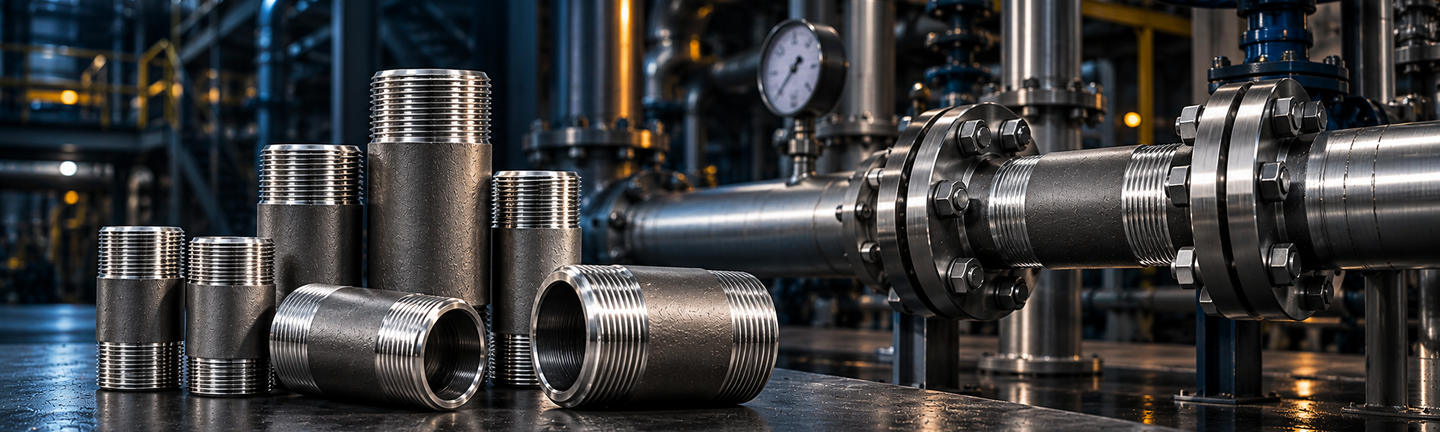
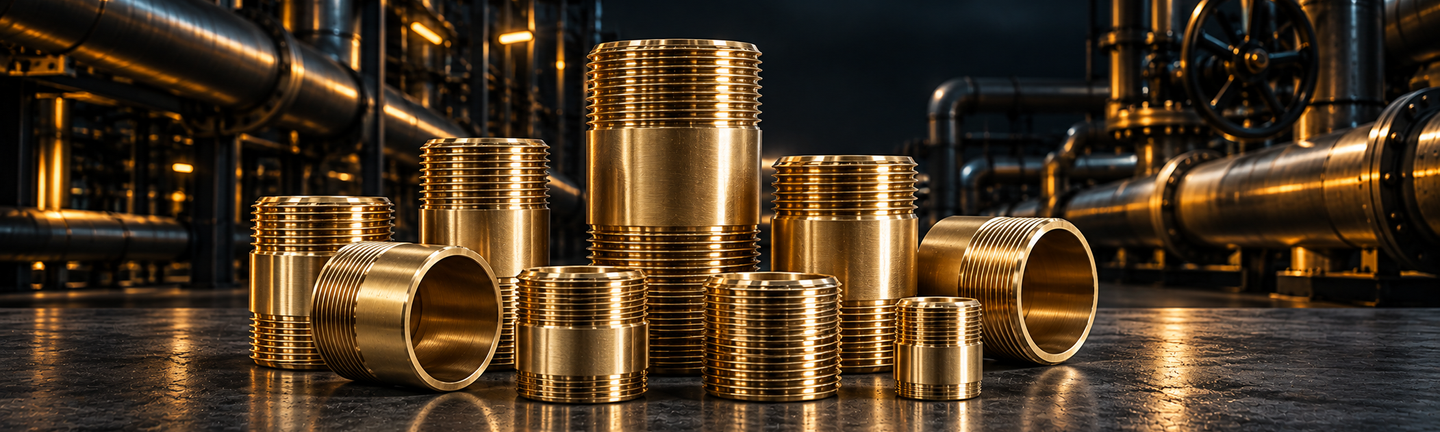
A threaded barrel (barrel nipple) is a short straight fitting with external pipe thread on both ends. It is used to join two components that have internal thread: a coupling and a valve, a filter and a manifold, or a valve and an equipment connection. In catalogues the same part may be listed as a close nipple, a short male–male nipple, or an MM threaded barrel without a centre hex.
Unlike a pipe union tail / sgon, a barrel usually has comparable thread length on both ends. A sgon is intended for assembly with a coupling and locknut when the pipe cannot be rotated. A barrel works differently: it simply connects two female threads into a compact, demountable joint without welding.
Where threaded barrels are used
In water supply they connect taps, filters, meters, tees and combination adapters. In heating they are fitted next to radiator assemblies, pumps, manifolds and shut-off valves. In technical lines a male–male fitting is convenient for local equipment connections that may later need dismantling.
For gas systems the part may be used only when the specific design, thread, sealant and installation method are allowed by the project and applicable rules. The same nominal size alone does not prove that a fitting is suitable for gas.
Common executions in this product group
Selection is based on length and material as well as diameter.
- Short (standard) barrel — when two valve bodies must sit as close as possible.
- Extended barrel — when a valve, filter or instrument must be offset to a required centre distance.
- Equal barrel — the same thread on both ends.
- Reducing nipple / barrel — different nominal sizes on the two ends.
Domestic and most building-services assemblies commonly use 1/2″, 3/4″, 1″, 1¼″, 1½″ and 2″ connections, corresponding to sizes such as DN15 and DN20. The actual range of diameters and lengths depends on the manufacturer and series. Exact ratings depend on the manufacturer, size and design and must be checked against the datasheet of the specific item.
An inch pipe-thread marking is nominal. “1/2″” does not mean the outside thread diameter is 12.7 mm. Parallel and taper threads also seal in different ways; BSP, BSPP and BSPT should not be treated as interchangeable without documentation.
Materials
There is no universally “best” material — it is matched to the medium and to adjacent metals.
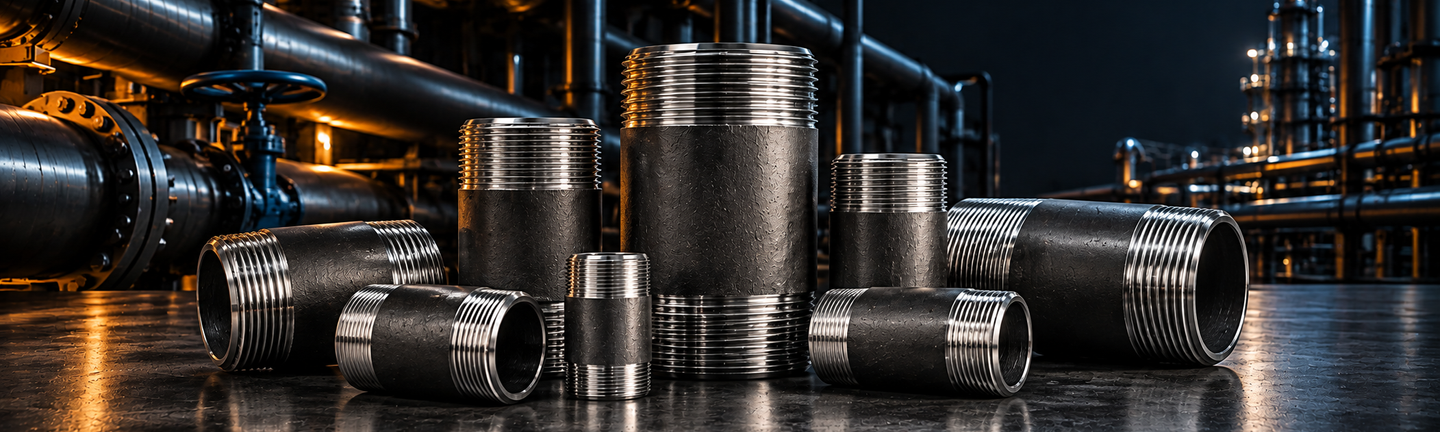
- Carbon steel — a common choice for steel water, heating and utility lines.
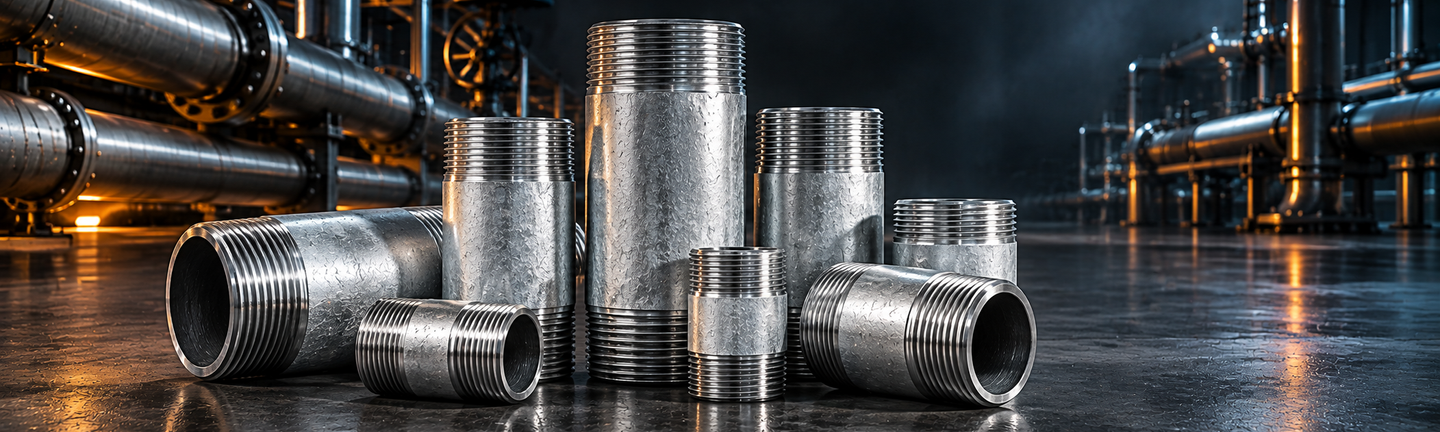
- Galvanized steel — extra surface protection; the coating on the thread must remain intact.
- Brass — practical for compact plumbing and brass valve assemblies.
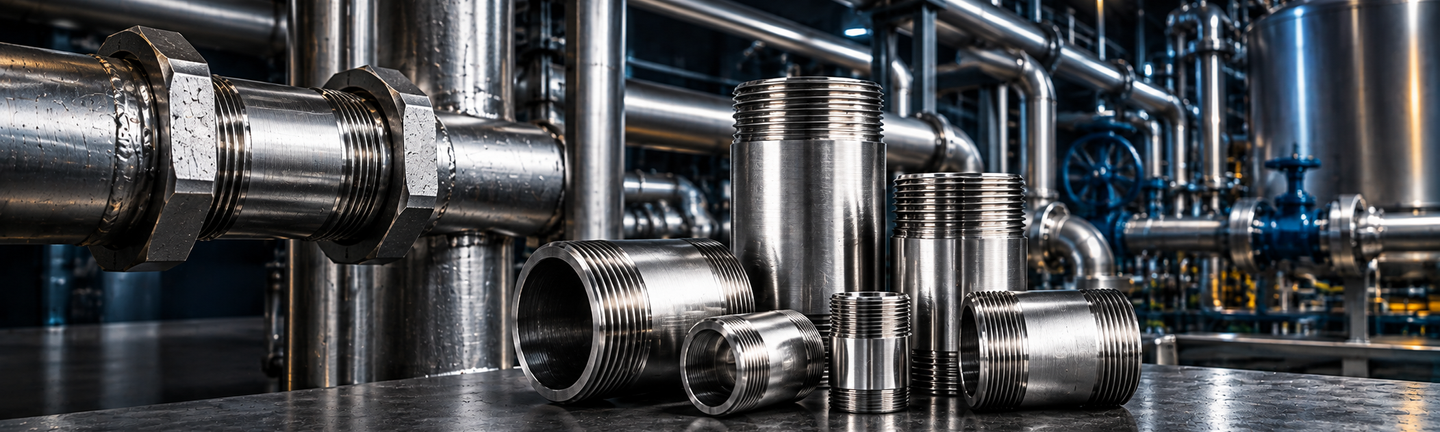
- Stainless steel — for higher corrosion resistance; the alloy grade must suit the medium.
For steel cylindrical pipe-thread fittings, engineering practice refers to standards such as GOST 8965 / GOST 8967 (nipples) and GOST 6357 for the thread form. Some series follow DIN / ISO barrel-nipple dimensions. These are compatibility guides, not automatic proof of every item’s pressure or temperature rating.
How to select without mismatch
- Confirm the nominal size of both female threads.
- Check the thread standard, profile and direction.
- Allow for engagement depth: part of each end disappears inside the mating component.
- Match material and coating to the medium, temperature and adjacent metals.
- Take allowable pressure and temperature from the product datasheet, not from diameter alone.
- Check wrench access: a classic barrel often has no centre hex; in a tight space a hex nipple is easier to hold.
- Choose the sealant with the thread, temperature and medium in mind: hemp with paste, PTFE tape or an anaerobic compound.
Do not infer working pressure from the words “steel” or “galvanized”. Different series with the same thread can have different ratings.
Installation and typical faults
Isolate the system and depressurise it. Clean chips, paint and old sealant from the thread. Start the first turns by hand: misalignment or sudden resistance means stop and re-check compatibility. Excess sealant and overtightening damage both the barrel and the valve or filter body. After assembly, test the joint by the procedure specified for that pipeline.
Leaks most often come from mixing parallel and taper threads, damaged crests, incorrect sealant application, or forcing incompatible parts together.
Buy a threaded barrel from Pipeline Systems of Ukraine
The online store pipelinesystems.com.ua supplies threaded valves and fittings for domestic and industrial pipelines. You can buy or order a threaded barrel for a specific assembly — wholesale and retail, with delivery across Ukraine. Price depends on diameter, length, material, coating and order quantity.
To avoid a thread mismatch, tell the specialist: the nominal size (for example 1/2″ / DN15), thread type, required length, material, working medium, temperature, pressure and quantity. Barrels are often supplied together with couplings, hex nipples, locknuts, reducing bushes and sealing materials as one compatible set.
Send a request on the website to confirm availability, the current price and the set needed for your site.
FAQ
How does a barrel differ from a hex nipple?
Both have external thread on two ends. A barrel usually looks like a short piece of pipe without a centre hex. A nipple more often has flats for a wrench, so it is easier to hold while tightening.
How does a barrel differ from a sgon?
A barrel has comparable thread length on both ends. A sgon has one short and one long thread so the joint can be made with a coupling and locknut.
Which size is most common in an apartment assembly?
Domestic connections often use 1/2″ and 3/4″ (DN15 and DN20). The deciding factor is the thread already present on the valves, not a “typical” riser diameter.
Can a galvanized barrel be used on any water line?
No. The coating does not replace a check of water quality, temperature, pressure and adjacent materials.
How do I calculate length?
Add the engagement into both female threads to the visible gap required between the two bodies. There is no universal engagement depth.