






|
Quantity
|
Total
|
||
|
|
|||
Dirt Separators and Strainers
Dirt separators and strainers remove sand, rust, scale and other suspended debris from water or heat-transfer fluid before it reaches sensitive equipment. They are installed upstream of pumps, heat exchangers, meters and control valves in heating, water-supply and district-heating systems. These devices provide coarse mechanical protection rather than fine filtration or water treatment. Correct selection limits avoidable pressure loss and leaves enough access for safe cleaning.
Main types of dirt separators and strainers
A Y-strainer directs the flow through a removable or cleanable screen. Debris larger than the screen openings collects in the angled pocket. Threaded connections are common on compact small-bore pipework, while flanged strainers suit larger lines where robust, serviceable joints are required.
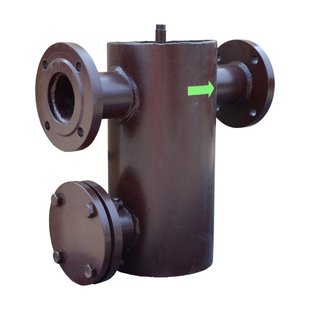
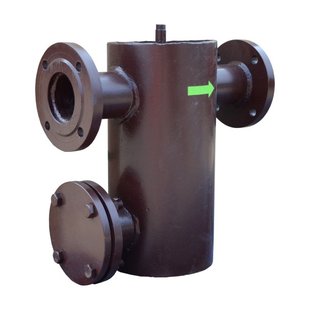
A settling-type mud collector uses an enlarged chamber to reduce flow velocity so that heavier contaminants drop into the lower section. Vertical subscriber-unit designs are used at heat-substation inlets and in hydronic heating networks, with flanged or welded-end connections depending on the design. A magnetic dirt separator also captures ferrous corrosion products and is particularly useful in closed hydronic circuits. The availability of any specific configuration should be confirmed before ordering.
Body materials and construction options
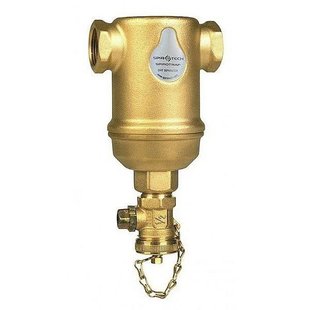
Brass and cast iron are typical body materials for compact Y-strainers, whereas larger settling units are commonly fabricated from steel. The screen is often made from corrosion-resistant metal because it must withstand repeated removal and washing. Body material affects fluid compatibility, connection design, installed weight and operating limits. Exact ratings depend on the manufacturer, size and configuration and must be checked in the product data sheet.
Where dirt separation equipment is used
In heating systems, a strainer or mud collector protects circulation pumps, heat exchangers, boiler-room equipment and control valves. In water systems, it provides preliminary mechanical filtration upstream of sensitive components but does not replace fine filtration or treatment. Industrial and municipal applications include heat substations, pumping stations and compatible process-water lines where suspended solids can impair equipment performance.
How to select the right unit
Start with the fluid, operating temperature and pressure, required flow rate and acceptable differential pressure. Match DN to the design bore and select a PN rating that is not lower than the system design pressure. Then verify body material, connection type, flow direction, screen opening and maintenance clearance. On liquid service, a Y-strainer pocket is normally positioned downward, but the manufacturer’s installation instructions take precedence. Price depends on construction, material, size, operating rating and supplied accessories.
Why order from PIPELINE SYSTEMS OF UKRAINE
Pipelinesystems.com.ua supplies pipeline equipment for wholesale and retail orders and offers product-selection support. Provide the system parameters and preferred connection type so the team can verify compatibility, current availability and cost. Delivery is available across Ukraine, while documentation for the selected item can be confirmed before payment.
Popular sizes
- DN 40 — for compact subscriber and distribution assemblies;
- DN 50 — a common bore for building-services pipework;
- DN 65 and DN 80 — for heat substations and pump circuits;
- DN 100 — for medium-capacity main lines;
- DN 125, DN 150 and DN 200 — for larger district-heating and industrial networks.
These sizes are general project-selection references; confirm the required connection and availability with the supplier.
CTA
Send your requirements to check the availability and price of a suitable dirt separator or strainer. A specialist will help match its size, connection and installation conditions to your system.
FAQ
Frequently asked questions about dirt separators and strainers
What is the difference between a settling mud collector and a Y-strainer?
A Y-strainer primarily retains particles on a screen inside an angled pocket. A settling collector also slows the flow so that heavier debris can fall into a lower chamber before it is drained or removed.
Where should a strainer be installed in a heating system?
Install it upstream of the pump, heat exchanger, meter or control valve that requires protection. Follow the body flow arrow and leave enough clearance to remove the cover, extract the screen and discharge accumulated debris.
How can operators tell that cleaning is required?
A rising differential pressure across the device or reduced circulation commonly indicates fouling. Inspection frequency should reflect actual system contamination and the manufacturer’s maintenance instructions rather than a calendar interval alone.
When is a magnetic dirt separator useful?
It is valuable in closed hydronic systems where fine ferrous corrosion products circulate with the fluid. Magnetic capture complements mechanical separation, but routine draining and cleaning are still required.
Can a Y-strainer be installed vertically?
Only if the product instructions permit that orientation and the flow direction allows debris to remain in the pocket. For liquid service, vertical installation is generally associated with downward flow; purpose-built vertical mud collectors must be fitted exactly as specified by their manufacturer.