









|
Quantity
|
Total
|
||
|
|
|||
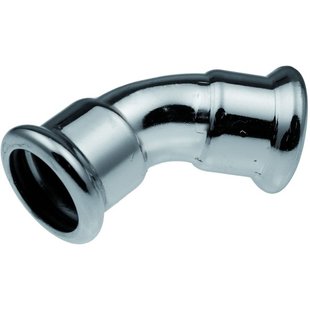
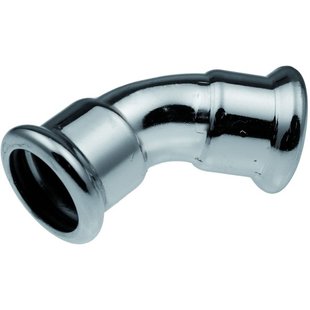
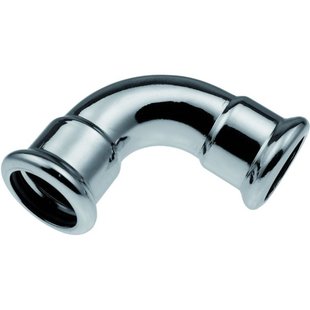
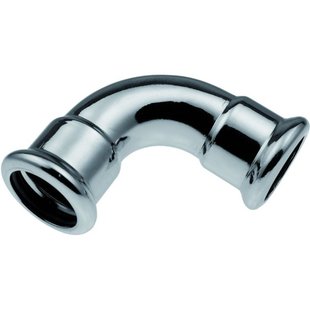
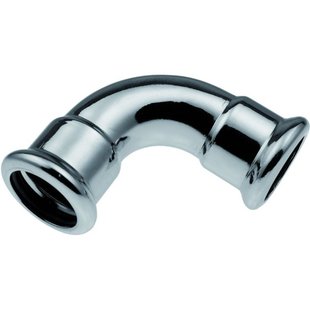
KAN-therm Steel elbows
A KAN-therm Steel elbow changes the direction of a zinc-coated press pipe without welding the tube. The fitting is pushed onto the pipe end and locked by a radial M-profile press: an EPDM O-ring and a three-point crimp keep the joint tight. These bends are used in closed heating, district-heat and process circuits where installers need a fast joint and a repeatable turn. A wrong angle, diameter or end type breaks the route and loads the next fitting, so the size should be checked against the node drawing before the order.
Main types of KAN-therm Steel elbows
The 90-degree press elbow is the basic bend with two press sockets. It is used for a riser turn, an obstacle offset or a manifold take-off when a square corner is required without a weld.
The 45-degree elbow changes direction more gently, on equipment approaches, ceiling runs and expansion sections. The smaller angle gives a lower local loss than a sharp turn.
A male- or female-thread elbow joins the press pipe to a valve, pump or heat exchanger. The thread should be made up before pressing so torque is not applied to a finished socket.
Reducing and nipple-end versions cover a diameter change or a male-thread outlet when one point must both turn the line and change the connection.
Materials and construction
System fittings are made from low-carbon steel with an external zinc coating and passivation. The zinc protects the outside, so these elbows should not be welded: local heat damages the layer. An EPDM O-ring in the socket is intended for closed water circuits, treated water and glycol solutions within the manufacturer’s limits. For some media the ring can be replaced with FPM; that is a separate execution, not the standard supply.
The joint is made with M-profile jaws or a press ring. Leak-before-press leaves an unpressed socket open, so a missed crimp shows up on the test. Exact pressure and temperature limits depend on diameter, tool and seal and must be read from the product data sheet. System documentation gives a typical 16 bar working pressure for the M profile on 12–108 mm, and an EPDM range of −35 °C to 135 °C with a short peak.
Where KAN-therm Steel elbows are used
The main use is closed heating and heat-supply systems in residential, commercial and industrial buildings: boiler plant, substations, fan coils and manifolds. In process circuits the elbows carry treated water and water-glycol mixes when the medium matches the seal rating. The system is not intended for potable water. Dry compressed air is acceptable only within the documentation for the relevant O-ring.
How to select a KAN-therm Steel elbow
Start with the pipe outside diameter in millimetres: most often 15, 18, 22, 28, 35, 42 and 54, less often up to 108. Then set the angle, 90 or 45 degrees, and the ends — press/press or press with a female or male thread. Match the thread to the equipment, not to a spare size. Medium, temperature and pressure must sit inside the seal and tool limits; 16 bar is the reference for the M profile. Also check insertion depth and jaw clearance. Price follows diameter, angle, thread and reduction: larger and threaded pieces cost more than a straight press elbow.
Why order from Piping Systems of Ukraine
In Kyiv and with delivery across Ukraine you can match a KAN-therm Steel elbow to the system pipe and complete the node with couplings, reducers and valves. Diameter, angle and connection are checked against the contractor or plant specification. Wholesale and retail are both available: a site order can be one size in quantity, a service call a few pieces for replacement. Confirm stock and price before dispatch; batch documents are supplied on request.
Popular sizes
- 15, 18, 22 and 28 mm — apartment and office runs, manifold outlets
- 28×28, 35, 42 and 54 mm — risers and equipment connections
- 90° press/press — riser turns and obstacle offsets
- 45° press/press — a gentler change of direction
- press with female or male thread — joint to valves and plant
- zinc-coated elbows up to 108 mm in the system range
Send a request to check stock and price for the KAN-therm Steel elbow you need. We will confirm angle, diameter and connection type for your route.
FAQ
Frequently asked questions about KAN-therm Steel elbows
How does a 90-degree elbow differ from a 45-degree bend? A square elbow is used where the line must turn onto a riser, a manifold or around an obstacle. A 45-degree bend changes direction more gently and has a lower local loss, so it is more common on equipment approaches and ceiling runs. Pick the angle from the drawing: two 45-degree pieces do not always replace one 90-degree turn without changing pipe lengths.
Can these elbows be used on drinking water? No. KAN-therm Steel is intended for closed heating and heat-supply circuits, treated water and water-glycol solutions within the seal rating. The manufacturer specifies other materials for potable water. If the medium is not closed-circuit water, the limit must be checked on the EPDM or FPM ring data.
Which press profile is required, and what is LBP? The standard joint uses M-profile jaws or a press ring. Leak-before-press leaves an unpressed socket open, so a missed crimp shows on the pressure test rather than after start-up. The tool must match the diameter: jaws are usual for 12–35 mm, rings with an adapter for larger sizes.
When should a threaded elbow be used instead of press/press? A threaded elbow is for the joint to a valve, pump, heat exchanger or another maker’s assembly. A straight press elbow stays inside a KAN-therm Steel pipe run. Make up the thread before pressing so the finished socket is not twisted. The thread sealant must not attack the zinc layer or the neighbouring socket.
Can the elbow be welded, or the pipe bent instead? Welding is not recommended: heat damages the external zinc. The manufacturer limits cold bending to smaller diameters; for turns above 28 mm the system supplies ready bends and 90° and 45° elbows. A factory elbow gives a repeatable geometry and does not depend on site bending skill.