






|
Quantity
|
Total
|
||
|
|
|||
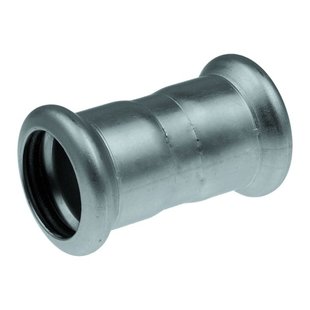
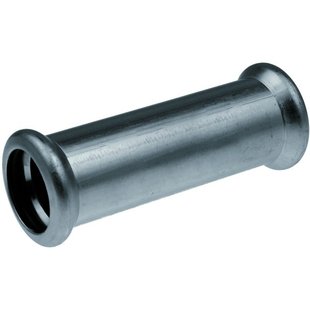
KAN-therm Inox coupling
A KAN-therm Inox coupling is a straight stainless-steel press fitting that joins two Inox system pipes without welding or threading. Sealing comes from a factory-fitted EPDM O-ring after the joint is pressed with an M-profile jaw. These connectors are used on heating risers and branches, potable and technical water lines, cooling circuits and selected process runs. A wrong diameter, seal or tool shows up at the pressure test, so the size should be matched to the pipe before ordering.
Main types of KAN-therm Inox couplings
An equal press×press coupling joins pipes of the same outside diameter. The body has two press sockets, each with its own seal. After calibration and pressing the joint is permanent. It is used on straight runs where a pipe length has to be extended or a standard pipe section assembled.
A reducing coupling joins two adjacent Inox diameters in one body. It shortens the assembly when the design does not call for a separate reducer. It is worth selecting only when both outside diameters match the pipes on site, not the nominal bore of a valve.
Materials and construction
The press coupling body is made of corrosion-resistant chromium-nickel-molybdenum steel. KAN-therm documentation for Inox fittings most often specifies grade 1.4404, close to AISI 316L. The exact grade should be checked on the product card: the system also includes 1.4404 pipe and ferritic 1.4521 pipe, and the fitting must match the pipe selected.
The standard seal is an EPDM O-ring. The manufacturer states a working range of about −35 °C to +135 °C, with short-term exposure up to +150 °C, for a compatible medium. Up to 54 mm the rings provide LBP: an unpressed joint leaks during the test fill. On larger diameters the same check is built into the fitting geometry. EPDM may be unsuitable for oils, fuels or aggressive chemicals — another seal is then required if the manufacturer offers it.
Where the KAN-therm Inox coupling is used
The stainless Inox coupling is used on closed heating and heat-supply circuits, on cold and hot potable water where the steel grade is suitable, on cooling loops and on technical lines with a neutral medium. A press joint is practical where welding is undesirable: occupied buildings, service shafts and sites with stricter cleanliness requirements. KAN treats sprinkler networks as a separate Inox Sprinkler range — a standard Inox coupling should not be substituted without checking the design.
How to select the coupling
Select by pipe outside diameter, not by thread or flange size. Common equal-coupling sizes are 15, 22, 28, 35, 42 and 54 mm, plus 76.1, 88.9 and 108 mm. Insertion depth and jaw type depend on diameter: up to 54 mm an M-profile jaw is normally used, larger sizes need press collars. With standard M-profile tools the manufacturer limits system working pressure to 16 bar across 12–168.3 mm; 25 bar applies only to specific combinations of pipe, diameter and HP tooling. Before ordering, confirm the medium, temperature, site tool set and article number.
Why order from Piping Systems of Ukraine
Piping Systems of Ukraine can match a press coupling to the Inox pipe already on site and check the article together with the pipe and adjacent fittings. We work with installers, designers and industrial buyers, supply wholesale and retail, and arrange delivery across Ukraine. Price depends on diameter and execution; stock and documents for a specific item are confirmed on request.
Popular sizes
- 15 × 15 mm
- 22 × 22 mm
- 28 × 28 mm
- 35 × 35 mm
- 42 × 42 mm
- 54 × 54 mm
- 76.1 × 76.1 mm
- 88.9 × 88.9 mm
- 108 × 108 mm
CTA
Send a request to confirm stock and price for the KAN-therm Inox coupling diameter you need. We will check the compatible size and the rest of the press joint.
FAQ
How does an equal press×press coupling differ from a reducing one?
An equal coupling joins pipes of the same outside diameter; a reducing coupling joins two adjacent diameters in one body. Both are pressed and cannot be dismantled afterwards. A reducer is appropriate only when both sizes match the pipes on that run.
What does LBP mean on an Inox coupling?
Leak Before Press is a check for an unpressed joint. Up to 54 mm special O-rings make an unpressed socket leak during the test fill, so it is easy to find. After an M-profile press the joint should be tight. On larger diameters the fitting geometry provides the same check.
Can an Inox coupling be used on galvanized or carbon-steel pipe?
No. It is sized for KAN-therm Inox pipe of the matching outside diameter and wall thickness. Mixing it with carbon or galvanized pipe changes both the press geometry and the corrosion behaviour of the joint. The Steel system needs fittings from that system.
What tool is required for installation?
Cut the pipe square, calibrate it and deburr, insert it fully into the socket and press with an M-profile jaw or collar. Up to 54 mm jaws are normally enough; from 76.1 mm press collars are required. The tool and jaws must be on the list approved by KAN-therm for Inox.
What drives the price, and what should the enquiry include?
Price rises with diameter and depends on whether the coupling is equal or reducing. For selection we need the pipe outside diameter, medium, temperature and quantity. A KAN-therm catalogue article speeds up the stock and kit check.