



|
Quantity
|
Total
|
||
|
|
|||
Expansion joints and vibration connectors are flexible pipeline elements that absorb thermal pipe movement and isolate the pipework from the vibration of pumps and other equipment. They are used in water supply, heating, hot water, pump assemblies and process lines. Each type has its own purpose, so first define the task, then select the product from the manufacturer's datasheet.
Types of expansion joints and vibration connectors
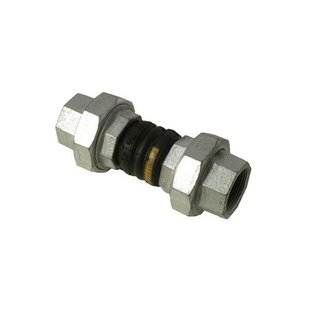
- Rubber vibration connectors. A reinforced elastomer body with flanges or threaded unions. It reduces vibration and noise transmitted from the pump to the pipes and takes small movements within its rated limits. See rubber vibration connectors.
- Axial bellows expansion joints. A corrugated metal bellows absorbs the thermal expansion of a straight run between anchors. Weld-end designs are in steel axial bellows expansion joints, flanged ones in flanged bellows expansion joint.
- Accessories. Covers, internal liners and tie rods are used only in the assembly specified by the manufacturer.
Expansion joints and water hammer
Bellows expansion joints and rubber connectors are not water hammer protection and do not replace a surge analysis. Only the manufacturer can confirm whether a specific model tolerates short pressure spikes. For causes and protection (slow valve closure, arresters near quick-closing fixtures, analysis for pumping stations) see water hammer in pipelines.
How to choose
Define the function: vibration isolation or thermal movement. Then check DN and PN, medium and temperature, end connection, face-to-face length and permitted movements. For rubber units, the elastomer (for example EPDM or NBR) must be compatible with the medium per the manufacturer's data; for bellows units, check the direction and amount of movement and the anchor and guide arrangement. For a side-by-side comparison see bellows expansion joint or rubber connector.
Select according to the manufacturer's datasheet; installation and pressure testing should be done by qualified personnel. Ask a specialist about availability and supply terms.
FAQ
What is the difference between a rubber connector and a bellows expansion joint?
A rubber connector mainly isolates pump or compressor vibration and noise and takes small movements. An axial bellows joint is designed for longitudinal thermal expansion of the pipeline.
Does an expansion joint protect against water hammer?
No, that is not its job. Water hammer protection is designed separately, and only the manufacturer can confirm which short-term loads the joint tolerates.
Can a rubber connector correct pipe misalignment?
Not beyond the movement rated for the model. Align the pipework and install supports first; otherwise the rubber body stays overloaded.
EPDM or NBR?
It depends on the medium, temperature and the manufacturer's recommendations. Compatibility is confirmed by the datasheet or chemical resistance table of the specific model.